

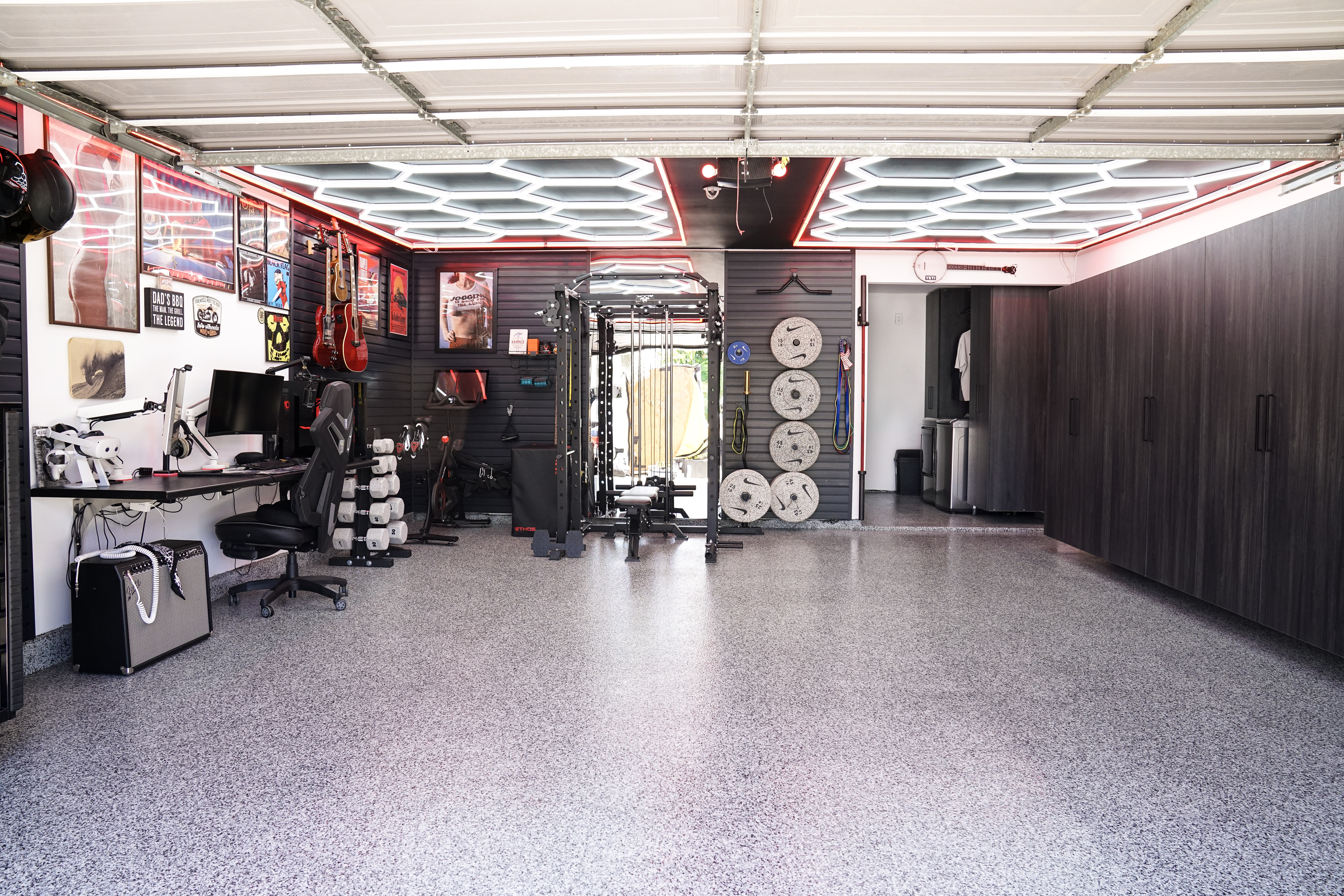
Can Designer Garage Flooring Increase Home Value in Orange County?
Short answer: yes, a finished garage floor can support resale value here — but not on its own, and not automatically. What moves the needle is the combination of the coating system you choose, the quality of the surface preparation underneath it, and whether the finish actually matches how the garage gets used. A showroom-grade floor over poorly prepped concrete will telegraph its flaws within a season; a well-installed one reads to buyers as a maintained, finished space rather than a storage closet with a car in it.
That makes the real decision a material question. The pages ahead compare epoxy and polyaspartic coatings on appearance, cure time, ultraviolet stability, and long-term wear, alongside modular tile systems that some Orange County homeowners prefer for their repairability.
Local conditions shape that choice. Coastal moisture migrating through slabs, hot tire pickup from cars parked after a summer drive, and buyer expectations in higher-end neighborhoods all narrow the field. So does use: a garage doing double duty as a gym, workshop, and parking bay asks more of a floor than one storing bins.
The sections below work through the garage flooring options Orange County homeowners weigh most often, and which fits which goal.
Orange County Factors That Shape Garage Flooring Choices
A garage floor in Orange County works under conditions that don’t apply everywhere. South- and west-facing doors let strong sun into the bay for hours, and an open door on a summer afternoon exposes the coating to direct ultraviolet light — which is why UV stability matters. Garage Living states that polyaspartic coatings resist UV yellowing and can last 10 to more than 20 years with proper care. Coastal humidity and winter rain add another variable: moisture moving up through a slab can undermine adhesion, and Floortek specifically calls out a vapor barrier for Orange County concrete. Ask any installer how they test slab moisture before quoting.
Daily use decides the rest. Cars pulled in on hot pavement create hot tire pickup, and a shared parking-plus-gym-plus-workshop bay adds dropped tools, oil, and cleaning chemicals. PremierGarage of Orange County’s epoxy flooring page describes a seamless finish built to handle heavy vehicle traffic, chemical spills, hot tire marks, and harsh chemicals while reflecting light and wiping clean.
Then there’s resale. Buyers touring a home here often walk through the garage first, and they read a bare, stained slab as deferred maintenance. Comparing garage flooring options in Orange County works best when climate, slab condition, and how you actually use the space lead the decision — with color and gloss chosen afterward.
Epoxy vs. Polyaspartic: Durability, Appearance, and Resale Appeal
Homeowners weighing garage flooring options in Orange County usually narrow the field to two resin systems. Both outperform bare concrete; they age and install differently.
| Criterion | Epoxy | Polyaspartic |
|---|---|---|
| Wear resistance | Thick, seamless build that handles vehicle traffic, dropped tools, and chemical spills | Hard topcoat marketed for chemical, stain, and hot-tire resistance |
| Appearance | Deep gloss that reflects light and brightens a dim garage; broad color and flake options | Similar flake and color range, typically with a harder, clearer topcoat |
| Cure and downtime | Multi-day cure between coats before vehicles return | Fast cure; some installers advertise one-day installation |
| UV behavior | Can amber over time where direct sun reaches the slab | Formulated to resist UV yellowing |
PremierGarage of Orange County’s epoxy flooring page describes its coatings as a seamless, high-end finish built to resist heavy vehicle traffic, hot tire marks, and harsh chemicals — the case for epoxy is depth of build and a showroom-style shine. Polyaspartic’s case is speed and sun tolerance: coating suppliers commonly claim ten to twenty years of service with proper care and resistance to UV yellowing, which matters when a west-facing door lets afternoon sun onto the slab for hours.
For a multi-use garage — parking, gym equipment, a workbench, seasonal storage — the practical question is downtime and traffic pattern. A household that cannot surrender the garage for several days leans polyaspartic. A homeowner prioritizing a thick, poured, monolithic look leans epoxy.
On resale, buyers read the same signals either way: even color, no peeling edges, no tire-shaped scars. Ask any installer for the moisture-testing and concrete-prep steps behind the warranty; that, more than the resin name, determines whether the floor still looks finished in year eight.
Flooring Choices for High-End and Multi-Use Garages

A finished-looking garage floor has to earn its keep. Beyond appearance, it needs to seal and protect the concrete slab underneath, wipe clean after oil drips or dropped paint, and hold up to vehicle weight, rolling tool chests, and dropped hardware. PremierGarage of Orange County describes its epoxy flooring as a seamless surface built to resist heavy vehicle traffic, chemical spills, hot tire marks, and harsh chemicals, while reflecting light into a space that’s often dim.
That seamless quality is the main dividing line when comparing garage flooring options in Orange County. A poured coating — epoxy or polyaspartic — leaves no seams for dirt, water, or gym chalk to collect in, which suits homeowners who park daily, wash the floor, or use the space as a workshop where sawdust and solvents are routine. Modular tile systems take the opposite approach. Pacific Closet & Garage promotes Swisstrax tile for Anaheim garages on the strength of easy repair, reinstallation, and a chemical-free install — genuinely useful if you rent, expect to reconfigure, or want to swap out a damaged section without recoating the whole slab.
For a multi-use garage, match the surface to the heaviest demand. Parking plus storage favors a coating, since cabinets and wall systems sit against a continuous floor and sweep clean underneath. A dedicated lifting platform or hobby bench may do fine over tile. Coatings also pair cleanly with storage planning: floor-to-ceiling garage cabinets and wall-mounted storage installed over a single uninterrupted finish read as one organized garage rather than several separate projects.
How Garage Flooring Can Support Resale Value Without Overpromising ROI
A finished floor changes how a garage reads to a buyer, but no coating comes with a guaranteed dollar-for-dollar return. What it reliably does is raise perceived quality. Bare concrete with oil stains and hot tire marks signals deferred maintenance; a coated surface that cleans with a mop signals a house that has been looked after. Garage Living, which installs polyaspartic systems, states those coatings can last 10 to more than 20 years with proper care while resisting chemicals, stains, hot tire pickup, and UV yellowing — useful longevity to cite in a listing, though a claim worth asking any installer to back with a written warranty.
Flooring rarely carries a showing on its own. It works alongside lighting, organized wall-mounted storage, and cabinetry that hides clutter, so the space photographs as usable square footage rather than overflow.
Buyer response also varies by use. A two-car parking garage rewards stain resistance and slip texture; a gym or workshop rewards a durable, comfortable surface underfoot. Weigh garage flooring options in Orange County against how the room is actually lived in — that, not the coating alone, is what buyers price.
FAQ: ROI, Resale Value, and the Best Finish for Premium Garages
Does a designer garage floor actually pay back? There’s no published return-on-investment figure for garage coatings, so treat any promised percentage with skepticism. What’s defensible is narrower: a coated floor removes an obvious defect. Garage Living’s writing on flooring upgrades and home value notes that quality polyaspartic coatings can last 10 to more than 20 years with proper care — meaning the finish is still presentable when you list the house, not a repair line item.
How does the finish influence resale? Buyers read condition, not product names. A floor with lifting edges or hot tire pickup reads as deferred maintenance. Coverage matters too: the coating should run wall to wall, under cabinetry lines, with a clean transition at the apron. And the palette should match the house — a showroom-bright garage under a muted exterior looks bolted on rather than finished.
Which finish suits a premium, multi-use garage? When the garage doubles as a gym, workshop, and parking bay, polyaspartic is usually the stronger pick. It cures fast enough to shorten downtime, resists UV yellowing near a west-facing door, and holds up to hot tires. Floortek, a local installer, promotes one-day polyaspartic installation and vapor-barrier prep for Orange County slabs — worth asking about if your concrete sits over damp soil.
When is epoxy still the right answer? For a seamless, polished, light-reflecting surface with strong everyday durability against chemical spills and dropped tools, epoxy remains a sound choice, as PremierGarage of Orange County’s epoxy flooring page describes.
Choose by use case: daily heavy use and sun exposure favor polyaspartic; appearance-first builds favor epoxy; rental or phased projects favor modular tile. To pressure-test which fits your slab and schedule, book a personalized consultation with PremierGarage of Orange County.
