

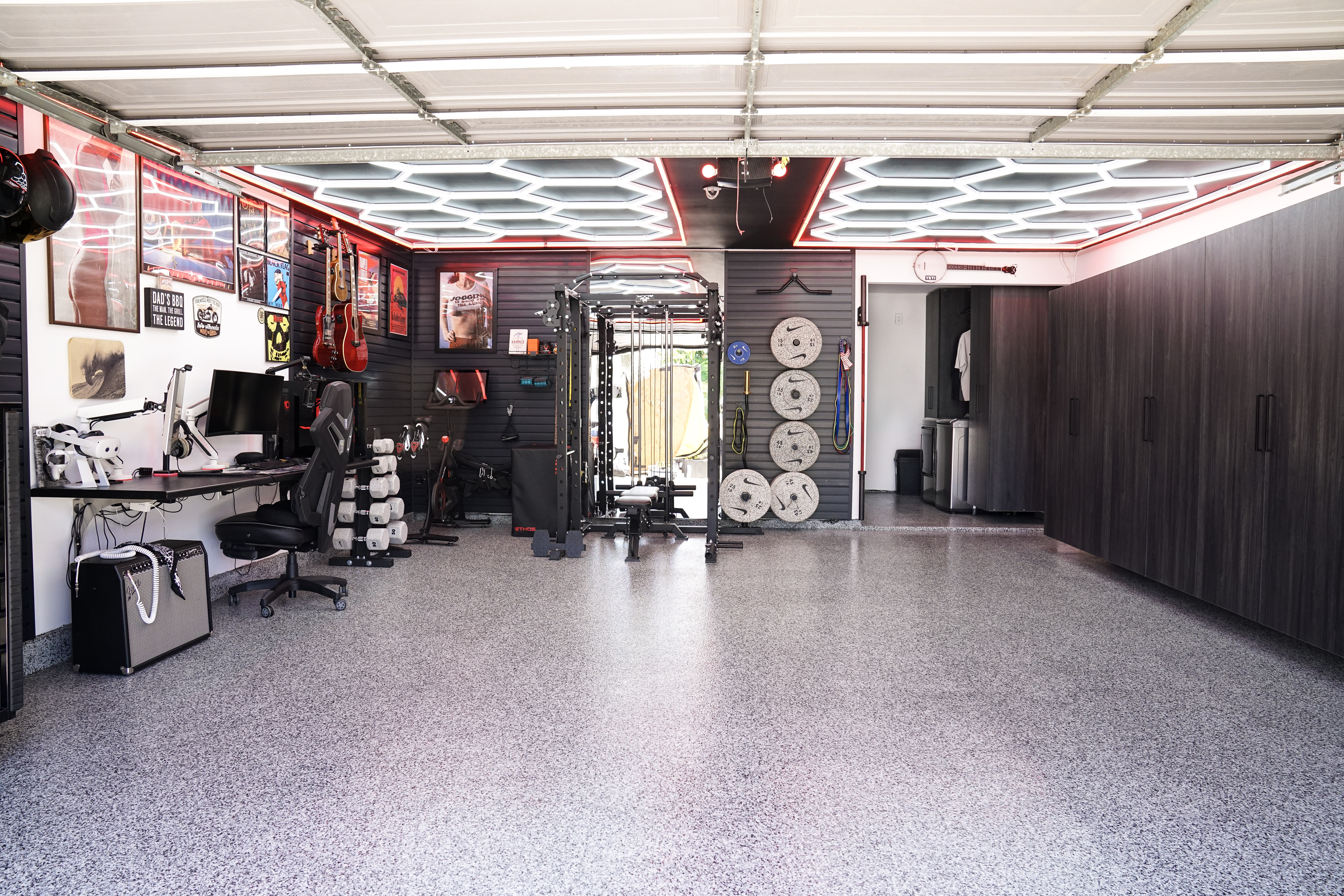
2026 garage floor choices for Orange County homes
Most homeowners here aren’t choosing between “bare concrete” and “something nicer.” The real decision is which coating system holds up to hot tires, dropped tools, and weekend projects while still looking finished five years in — and which one fits how the garage actually gets used.
2026 update: Buyers are asking sharper questions than they were a few years ago. Three shifts stand out. UV stability matters more, because sun through an open door can amber a coating that wasn’t formulated for it. Cure time matters more, with same-day and next-day return-to-service now a common expectation rather than a premium. And finish preferences have moved toward controlled flake blends, quartz broadcasts, and restrained metallic effects instead of heavy color splatter.
Multi-use space drives a lot of this. A single Orange County garage may hold two cars, floor-to-ceiling garage cabinets, a rack of bikes, and a workout corner — each of which stresses the floor differently.
What follows is a practical comparison of epoxy, polyaspartic, and modular garage tile across durability, maintenance, and appearance, then guidance on selecting a finish and a list of questions worth asking any installer before you request a quote on durable floor coatings in Orange County.
Epoxy, polyaspartic, and garage tile compared for high-end garages

The three finishes Orange County homeowners actually choose between behave differently once a hot car parks on them.
| Epoxy coating | Polyaspartic coating | Modular garage tile | |
|---|---|---|---|
| Durability | Thick film with strong bond to prepared concrete; resists dropped tools and chemical spills | Cures in hours rather than days, so vehicles return sooner; more color-stable under direct sun | Interlocking panels handle traffic well and can sit over concrete with minor surface cracks |
| Appearance | Solid color, flake broadcast, or quartz blends; metallic pours for a deeper, marbled look | Usually the clear topcoat over a flake or metallic base, holding gloss longer outdoors | Grid or checkerboard patterns, wide color mixing, visible seams between tiles |
| Maintenance | Continuous surface sweeps and mops with no grout lines | Same continuous surface, with better resistance to yellowing near an open garage door | Individual tiles can be lifted and replaced; seams trap dust and water can migrate underneath |
| High-end fit | Strong value when the goal is one uninterrupted floor | Best when downtime matters or the bay gets hard afternoon sun | Suits a highly customizable, changeable layout rather than a poured finish |
Hot-tire pickup is the practical test in this climate. It is driven mostly by concrete preparation — grinding, moisture testing, crack repair — rather than by the product label, which is why two floors using the same resin can perform very differently.
Flake systems remain the most common request in finished garages because they hide dust and add slip texture; metallic finishes read more dramatic and show wear sooner. When comparing durable floor coatings, Orange County buyers should ask which layers are quoted, not just the top color.
How to choose a finish for a multi-use garage

Start with how the space is actually used, not with a color chip. A garage that sees two vehicles in and out daily needs a heavier build — typically an epoxy base with a polyaspartic topcoat — while a storage-only bay or a home gym corner can be served by a lighter protective coating. Workshops add a different demand: dropped tools, solvents, and point loads from rolling cabinets.
Moisture comes next, and it decides whether any coating lasts. Slabs in coastal and older inland neighborhoods can push vapor upward, so ask the installer to test slab moisture and to mechanically grind rather than acid-etch before applying anything. Prep failures, not product failures, are what usually lift a floor.
Hot-tire pickup is the Orange County stress test. Tires that come home hot from the freeway can pull a weakly bonded film off the concrete, so ask specifically how the system resists it — bond strength, cure schedule, and the return-to-parking window.
Then choose the look. Solid color reads clean and modern; decorative flake adds texture and hides dust and minor slab imperfections; quartz gives a more refined, uniform surface with grip; metallic creates depth and movement. Durable floor coatings in Orange County should match both the traffic and the room’s job.
What Orange County homeowners should ask before requesting a quote
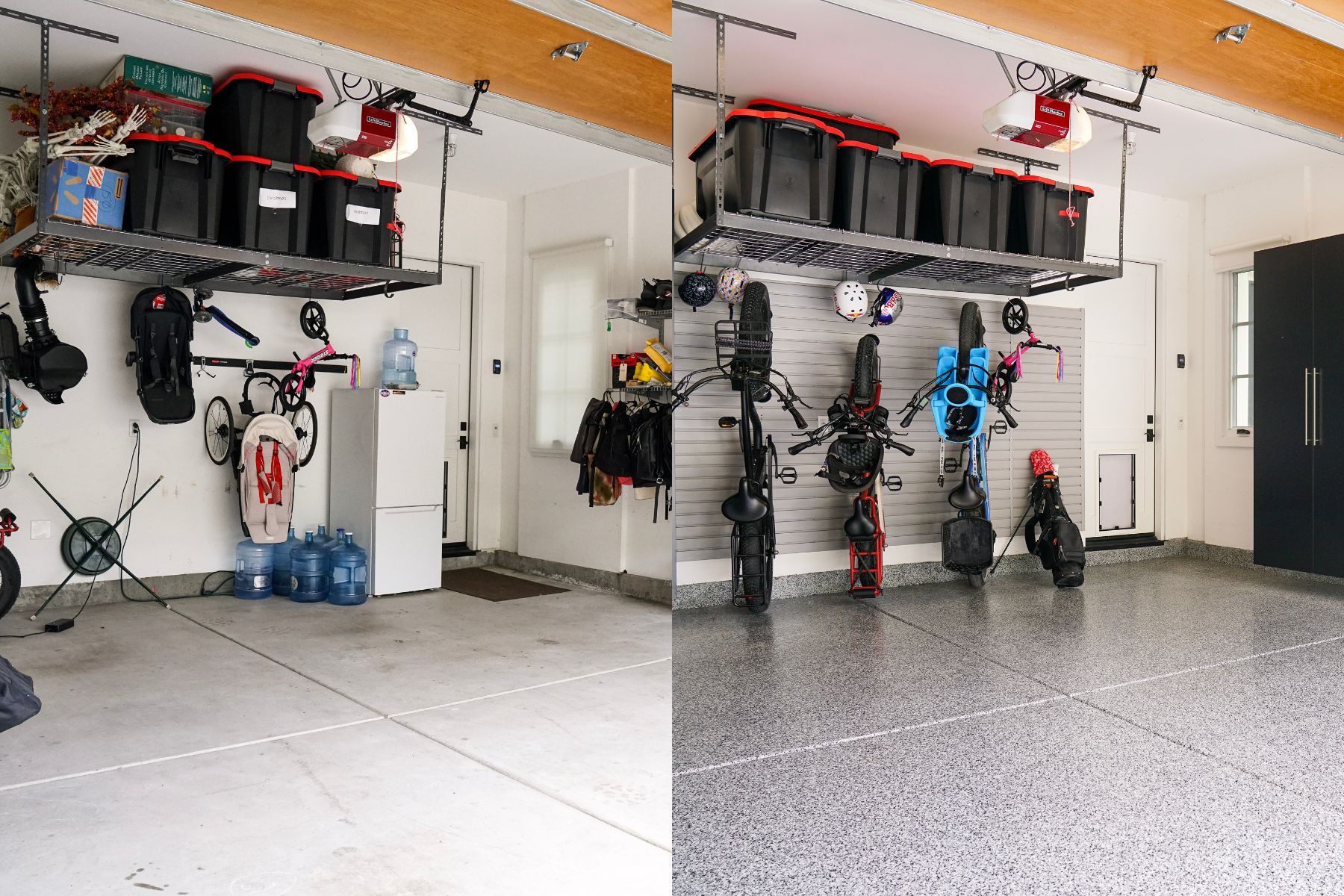
Two bids can look identical on paper and produce very different floors. The variable is almost always preparation, so start there. Ask whether the company is licensed and bonded, and verify the license number yourself through the California Contractors State License Board lookup. Then ask who actually grinds the slab — an in-house crew or a subcontractor — and whether they use diamond grinding or shot blasting rather than acid etching.
Slab condition questions come next. Request moisture testing before any coating is quoted, ask how cracks, spalling, and old sealer will be repaired, and find out what happens if the grind reveals a problem after the contract is signed.
On scheduling, get specific: how long the cure takes, when you can walk on the floor, and when vehicles can return. Polyaspartic and hybrid systems typically return to service faster than traditional epoxy, which matters in a garage you park in daily.
Finally, confirm the details that outlast the install — written warranty terms, what voids them, maintenance guidance, and whether the proposed system matches your actual use, whether that’s a daily driver, a workshop, or a showroom-style space with metallic or quartz-flake finishes.
Homeowners comparing durable floor coatings in Orange County should also expect a personalized consultation, and, where offered, 3D planning that shows color, flake blend, and layout before work begins.
What current Orange County examples suggest about durability and service
Local installer claims are a useful snapshot of what the market is promising right now — and how differently companies position themselves. Smart Garage Floors points to more than 25 years serving Southern California and over 5,000 residential garages completed, and states a 10 to 15 year service expectation when the coating is installed properly. That figure is worth treating as the realistic benchmark when you compare quotes for durable floor coatings in Orange County.
Speed is another axis. Bulldog Garage Products advertises one-day installation and says its coatings resist staining, chipping, chemicals, cracking, and denting. South Coast Epoxy emphasizes a different mix: 20-plus years in business, 200-plus completed projects, a lifetime warranty claim, and decorative metallic 3D floors alongside chemical and heat resistance.
Read together, these examples show three distinct selling angles — schedule, decorative range, and warranty language — rather than one standard. Homeowners weighing polyaspartic topcoats, flake blends, quartz broadcasts, or metallic finishes should ask each company to put its stated lifespan and warranty terms in writing.
FAQ: pricing, lifespan, timing, and maintenance
What actually drives the price? Four variables move a quote more than anything else: the condition of your slab (cracks, pitting, oil saturation, moisture), the depth of prep — diamond grinding or shot blasting versus a light acid etch — the coating system itself, and the decorative layer. A full-broadcast flake or quartz finish uses more material than a light broadcast, and metallic pours are labor-intensive. Garage size matters, but a rough two-car slab can cost more than a clean three-car one. Ask for prep and materials to be itemized separately.
How long should the floor last? Smart Garage Floors states an expected life of 10–15 years for a properly installed floor, and that framing is reasonable for a well-prepped system. Polyaspartic topcoats generally hold color better under Orange County sun exposure than a straight epoxy, which is worth weighing for garages that sit open all afternoon. When a company advertises a lifetime warranty — as South Coast Epoxy does — read what it covers: adhesion failure is not the same as wear, gloss loss, or yellowing.
How long does installation take? Grinding, crack repair, and coating are often completed in one or two days; Bulldog Garage Products markets a one-day install. The number that matters is return to service. Ask specifically when you can walk on it, when you can park on it, and how humidity or a cool morning changes those windows. Hot-tire pickup usually traces back to parking too early.
What does upkeep involve? Sweep or dust mop, rinse with a mild cleaner, and wipe spills before they sit. Skip harsh solvents, and lift heavy jack stands rather than dragging them.
For a floor matched to your slab and how you use the space, request a personalized consultation with PremierGarage of Orange County.
